
ROOMBEES - Find the Right Room. Match with the Right People
RoomBees helps users discover rooms and match with compatible roommates, removing the stress from shared housing.
Role
Chief Designer
Co- Founder
Timeline
19 months
(Jun’ 24 - Dec’ 25)
Project type
Available on Web, Android and iOS
Team
1 Chief Designer
1 Business Analyst
1 Team Lead
8 Developers

Overview
RoomBees began as an academic project in the Human-Computer Interaction master’s program and evolved into a real-world product. What started as a classroom exploration of shared living challenges became a live platform helping people discover rooms and compatible roommates with confidence. Today, RoomBees has 150+ active users and continues to grow.
Team Goal

Our goal was to design a solution that reduced the stress, uncertainty, and friction people face when navigating shared housing. We aimed to move beyond generic listings and create an experience that prioritized compatibility, trust, and clarity from the very beginning of the roommate journey.
Research & Analysis
Understanding & validating the problem
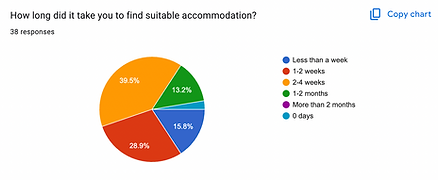
I conducted surveys, interviews, and informal usability testing with students and young professionals. Research revealed that users struggled most before moving in—during discovery and decision-making. Key insights highlighted trust concerns, mismatched expectations, and the need for clearer signals around availability, preferences, and intent.



Secondary Research
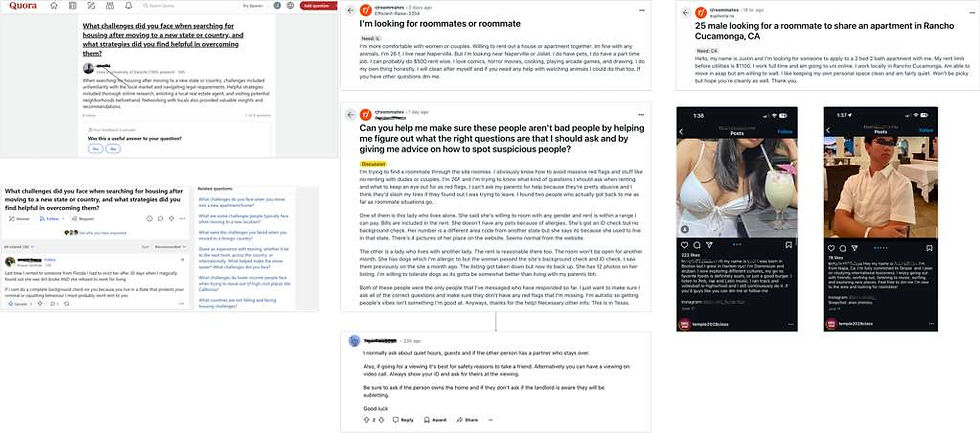
I reviewed existing roommate and housing platforms, online forums, and social media groups commonly used by students and young professionals. This included analyzing popular listing websites and community-driven groups to understand current solutions, gaps, and user behavior patterns.
Problem and Solution
A synopsis of the problem and solution
Making life easy for students
People searching for roommates and shared housing rely on fragmented tools like social media groups, outdated listing sites, and word of mouth. These options lack trust signals, compatibility insights, and structured communication, making the process time-consuming and risky.
Feature 1: HiveNest

HiveNest breaks it down by individual rooms. Each room can have its own price, size, and availability, making it easier for people to join an existing household without coordinating externally. This reduces confusion for both landlords and tenants and supports flexible, room-by-room occupancy.
Feature 2: Roommate Search

Users can browse profiles, understand preferences, lifestyles, and intent, and start conversations directly within the platform. The focus is on reducing mismatches early by making expectations clear before anyone commits to living together.
Feature 3: Room Search
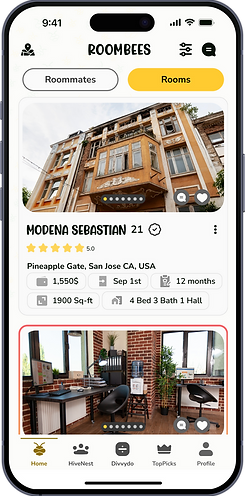
Room Search allows users to discover available rooms and shared housing in specific locations. Listings are structured and easy to compare, with clear details around pricing, availability, and house type. This removes reliance on scattered social media posts and outdated listing sites
Feature 4: Divydo

Divydo helps roommates manage shared expenses once they start living together. Users can divide amounts, track who owes what, send reminders, and mark payments as settled.
User Flow
I created a simple user flow to map the user journey within the app and ascertain the most effective and efficient user interactions


Thinking Business
Profitability of our application
Beyond design, we considered scalability and sustainability. RoomBees was built with growth in mind, supporting future features like verification, premium listings, and partnerships. This ensured the product could evolve beyond a class project into a viable platform.
Key Learnings
My learnings after leading the project
This project reinforced the importance of solving the right problem. Pivoting based on research allowed us to move from a conceptual academic idea to a live product with real users. It highlighted how user-centered design, when paired with product thinking, can create meaningful real-world impact.

